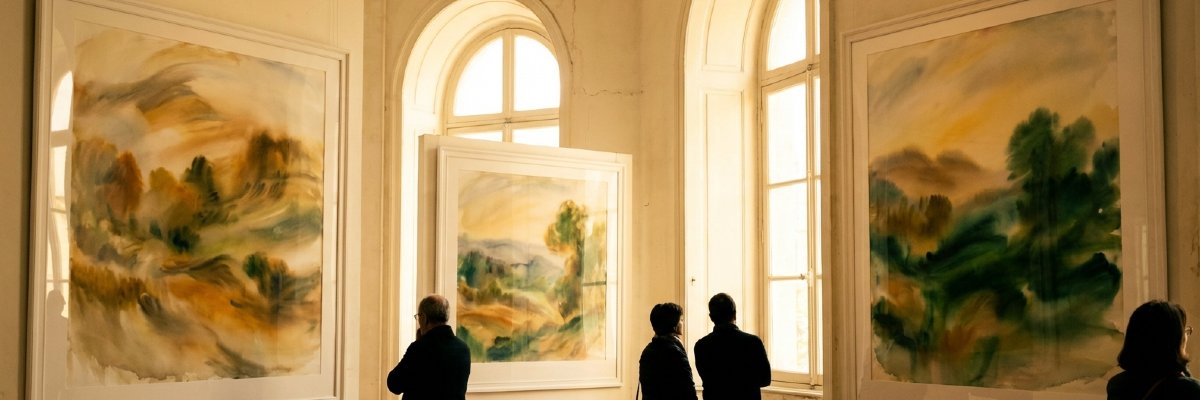
Understanding art movements enriches your painting practice. A guide to 10 essential movements from the Renaissance to contemporary art, their representative artists, and how to discover your own style.
Why is it so important to know about art movements?
Art history isn't just for museums and academies. Understanding a movement—its colors, brushstrokes, and perspective—deepens your painting practice far more than you might think. A watercolorist familiar with Impressionism sees the sky differently. A student familiar with the Renaissance uses light and shadow differently. Art history is not a limitation, but an endless source of inspiration—and each movement holds a mirror up to you, helping you find your own style. The Bysirvan Art Guide features 263 artists, 824 masterpieces, and 22 movements in 9 languages. In this article, we open the door to that guide—with 10 essential movements to nourish your watercolor practice.
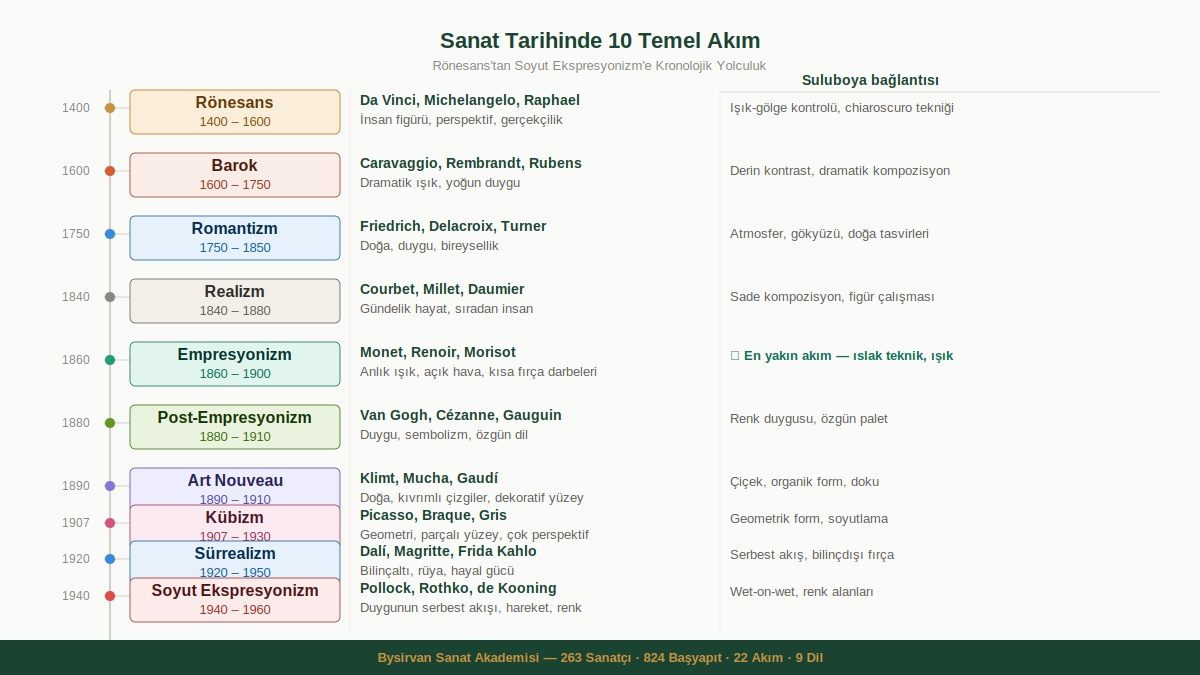
10 Fundamental Movements in Art History
Chapter 2 — text
Title: 10 Fundamental Movements in Art History
Renaissance (14th-17th centuries) — A Revolution Centered on Humanity Breaking away from the religious symbolism of the Middle Ages, this movement, which centered on the human figure, nature, and realism, is the foundation of modern art. The chiaroscuro technique, using light and shadow, perspective, and anatomical accuracy are distinctive features of the Renaissance. Representatives: Leonardo da Vinci, Michelangelo, Raphael.
Baroque (17th-18th centuries) — Dramatic Light, Strong Emotion The balanced compositions of the Renaissance were replaced by dramatic light-shadow contrasts and intense emotional expression. Caravaggio's harsh light and Rembrandt's portraits represent the peak of this movement. Representatives: Caravaggio, Rembrandt, Rubens.
Romanticism (18th-19th centuries) — The Triumph of Emotion Born as a reaction to the Industrial Revolution and rationalism, this movement brought emotion, nature, and individuality to the forefront. Stormy seas, majestic mountains, and dramatic skies are indispensable themes of Romanticism. Representatives: Caspar David Friedrich, Eugène Delacroix, J.M.W. Turner.
Realism (19th century) — The Dignity of Everyday Life This movement democratized art by focusing on the daily lives of ordinary people instead of mythological and historical subjects. Farmers, workers, and street scenes became serious subjects of art for the first time. Representatives: Gustave Courbet, Jean-François Millet, Honoré Daumier.
Impressionism (19th century) — Capturing Light This is the movement that most inspired watercolorists. Short brushstrokes, pure colors, and shimmering surfaces, aiming to capture fleeting light and atmosphere outdoors rather than in a studio, are the spirit of Impressionism. Representatives: Claude Monet, Pierre-Auguste Renoir, Berthe Morisot.
Post-Impressionism (19th-20th century) — Bringing Emotion to Color This movement, accepting Impressionism's observation of light but adding emotion and symbolism, opened the door to modern art. Each artist developed their own unique language. Representatives: Vincent van Gogh, Paul Cézanne, Paul Gauguin.
Art Nouveau (19th-20th century) — The Elegant Lines of Nature Curved lines, floral motifs, and decorative surfaces inspired by nature are the signature of Art Nouveau. Extending from architecture to illustration, jewelry to posters, this movement brought art into everyday life. Representatives: Gustav Klimt, Alphonse Mucha, Antoni Gaudí.
Cubism (20th century) — Breaking Perspective Showing an object from multiple angles simultaneously instead of a single point of view, this movement accomplished one of the most radical revolutions in art history. Geometric forms and fragmented surfaces define Cubism. Representatives: Pablo Picasso, Georges Braque, Juan Gris.
Surrealism (20th century) — The Stage of the Subconscious: Dreams, this movement brought a completely new dimension to art by transferring the subconscious and the irrational world of imagination to the canvas. Images that blur the line between reality and imagination are the essence of Surrealism. Representatives: Salvador Dalí, René Magritte, Frida Kahlo.
Abstract Expressionism (20th century) — The Free Flow of Emotion: Aiming to transfer emotion directly onto the canvas instead of figure and subject, this movement made brushstrokes, color, and movement the primary means of expression. It carries an understanding very close to the spirit of free flow and wet-on-wet techniques in watercolor. Representatives: Jackson Pollock, Mark Rothko, Willem de Kooning.
Which style is your style?
Learning art history is not just about understanding the past, it's about understanding yourself. Finding which movement resonates with you is the first step in discovering your own painting style. Ask yourself these questions:
If you want to capture nature, light, and the moment — Impressionism is for you. Monet's lily ponds and Renoir's luminous gardens come to life in watercolor with the wet-on-wet technique.
If you want to emphasize emotion and color — Post-Impressionism is your world. Van Gogh's stormy skies and Cézanne's geometric fruits meet with a unique understanding of the palette.
If you are interested in flowers, leaves, and organic forms — Art Nouveau will inspire you. Klimt's golden details and Mucha's elegant lines combine with texture and delicacy in watercolor.
If you want to work freely, instinctively, and spontaneously — Abstract Expressionism awaits you. Put down the brush, let the water and paint flow freely — that's exactly the spirit of the wet-on-wet technique. If you're looking for dramatic light and deep shadows — the Baroque chiaroscuro is reborn in watercolor through tonal studies. Don't worry if you don't know it yet — style emerges naturally through experimentation and time. The 22 movements and hundreds of artists in the Bysirvan Art Guide will accompany you on this journey of discovery.
Discover hundreds of artists and 22 movements.
Reading art history is wonderful — but experiencing it is even better. The Bysirvan Art Guide offers 263 artist biographies, 824 masterpieces, and information on 22 art movements, all in 9 languages.