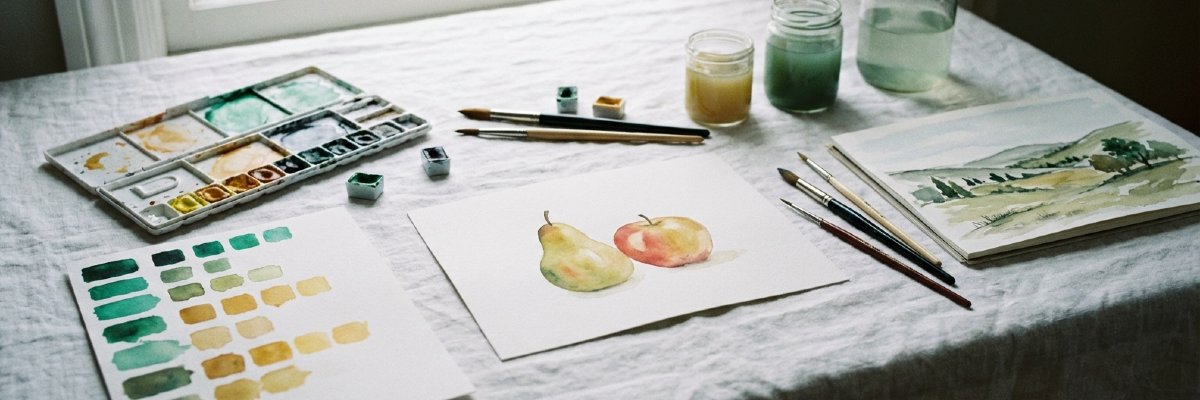
Not randomly, but learning in the right order changes everything in watercolor. Şirvan Hoca's curriculum, developed over years, step by step in this article.
Why is learning in the correct order so important?
Most people who want to learn watercolor painting find a video online, choose a subject they like, and start there. The result is often disappointment — because technical knowledge is lacking, the fundamentals are skipped, and progress is not felt. Having worked with thousands of students for years giving online lessons, Şirvan Hoca observed that students who learn in the correct order progress faster, experience less disappointment, and retain what they learn. The order is not random — each step prepares the ground for the next. You cannot learn technique without knowing the material, and you cannot create a composition without knowing the technique.
At Bysirvan, lessons are recorded — you can watch them again as many times as you want, whenever you want. This opportunity for repetition, combined with the right curriculum, makes the learning process much more efficient and permanent. This article describes Şirvan Hoca's watercolor curriculum, which he has developed and perfected over the years, step by step. You will find where to start, in what order to progress, and what you will learn at each step.
Over the years, this curriculum has attracted the interest of many — some have tried to emulate it, while others have directly adapted it to their own education. The imitation of an approach is the quietest proof of its value. But the true power of a curriculum doesn't come from the ordinary text on paper, but from the experience, intuition, and commitment to the student of the instructor who developed it. Here, you are learning about Professor Şirvan's curriculum from its source.
Getting to Know the Material
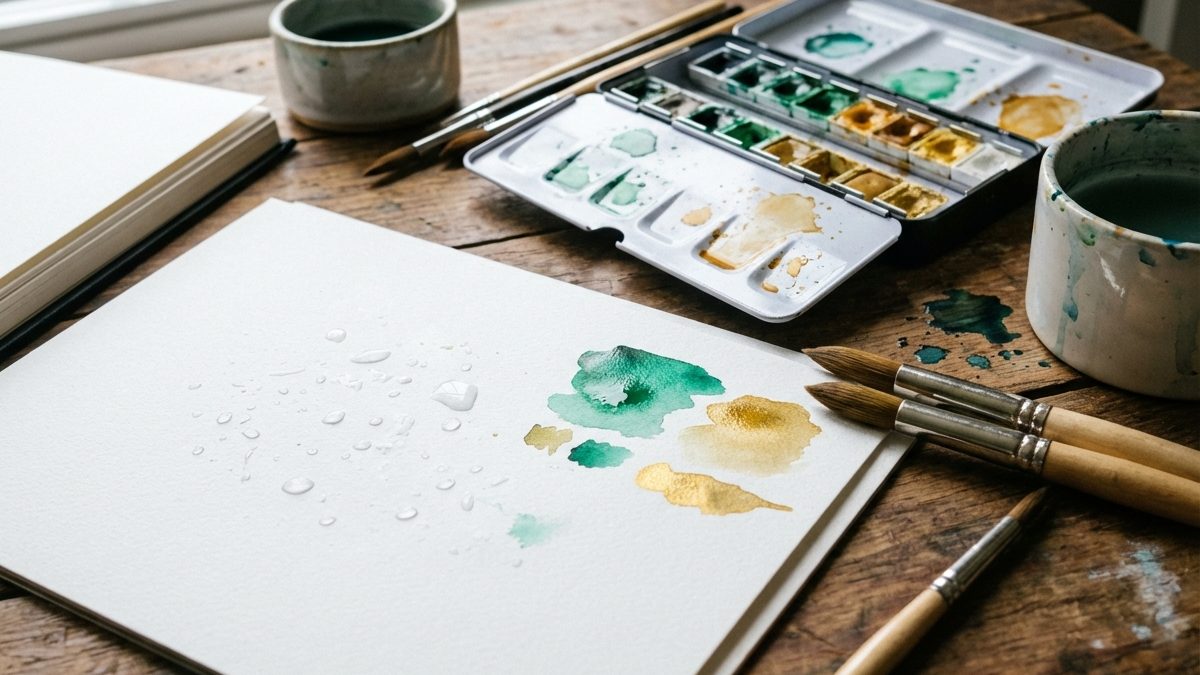
The first step in the watercolor journey isn't holding a brush, but getting to know the material. Şirvan Hoca first explains the tools at hand to each new student — because a student who doesn't know the material can't understand why they get a certain result when applying techniques. This step includes learning:
The difference in paper surfaces — experiencing firsthand how cold press, hot press, and rough surfaces behave differently with water and paint. The same paint will produce completely different results on different papers.
Paint pigments — transparent and opaque colors, granulation, color fastness. Knowing how each paint behaves makes color mixing more conscious. Brush characteristics — how much water each brush holds, how it reacts, and what movement it's designed for. Knowing your brush makes it possible to use it like an extension of yourself. This step requires patience, but it lays a solid foundation. A student who knows the material is much better prepared for the next step.
Scale Study
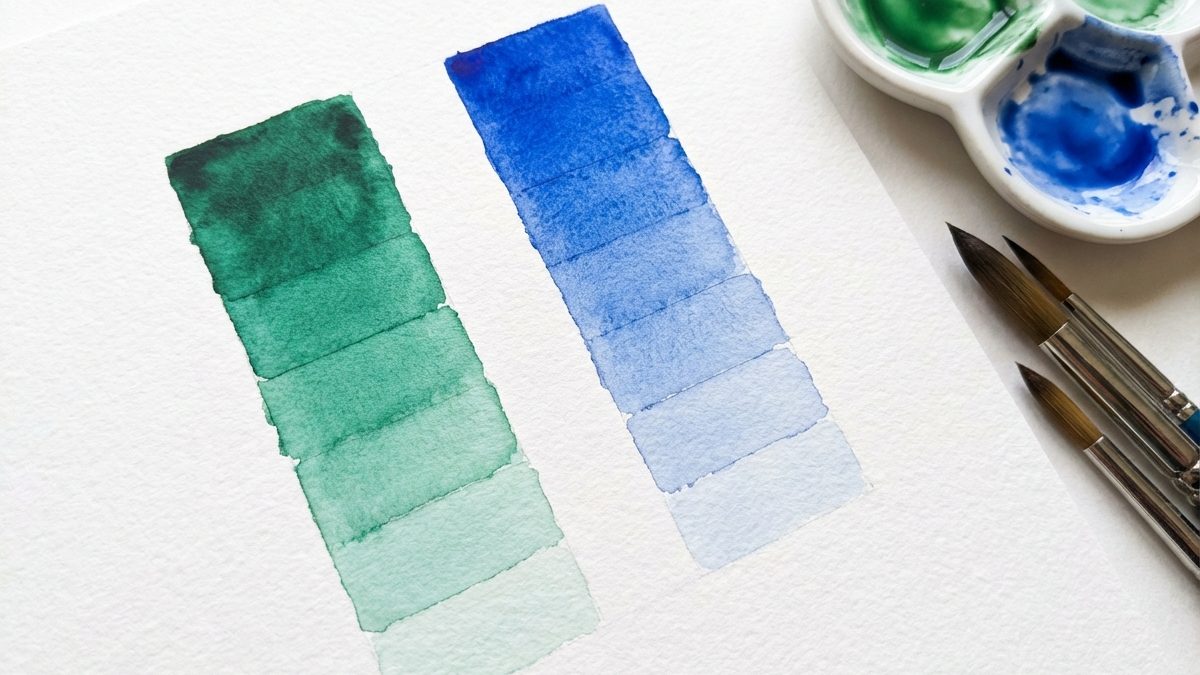
After familiarizing the material, the next step for the student is scale work. Scale is the most effective way to teach color and tone control in watercolor — seemingly simple, but what it teaches is profound. This step will teach:
Color scale — transferring a single color from lightest to darkest onto paper. Controlling water volume, adjusting color intensity, and creating smooth transitions are learned through this exercise.
Tone scale — achieving tonal transitions from light to dark. Understanding light and shadow in watercolor and creating depth requires tone control.
Color mixing scale — transferring the transition between two colors by mixing them in different ratios onto paper. Seeing how colors communicate with each other takes color theory from abstract to concrete. Scale work may seem boring to some students — but Professor Şirvan's observation is clear: students who skip this step will struggle with water and color control in later lessons. Scale work is actually a form of meditation — a repetitive, calming, and focusing practice.
Not all levels are in the same class.
A common problem in online art education is that students of different levels are brought together in the same class. A beginner, before even getting to know the brush, is exposed to advanced topics, becomes overwhelmed, and gives up. Or vice versa — an experienced student is constantly forced to repeat basic concepts and cannot progress. Another common mistake is skipping the basics. The "Let's paint a bird now" approach seems exciting at first — but learning without a foundation is not lasting. The student experiences the moment, but repeats the same basic mistakes in the next work. At Bysirvan, education is structured in three separate levels: beginner, intermediate, and advanced. Each level is a whole in itself — you don't move on to the next level without establishing the right foundation. In addition, special workshops are organized for advanced students. Each student progresses at their own level, at their own pace, with the right content — they neither fall behind nor become overwhelmed.
Simple Fruit and Flower Studies
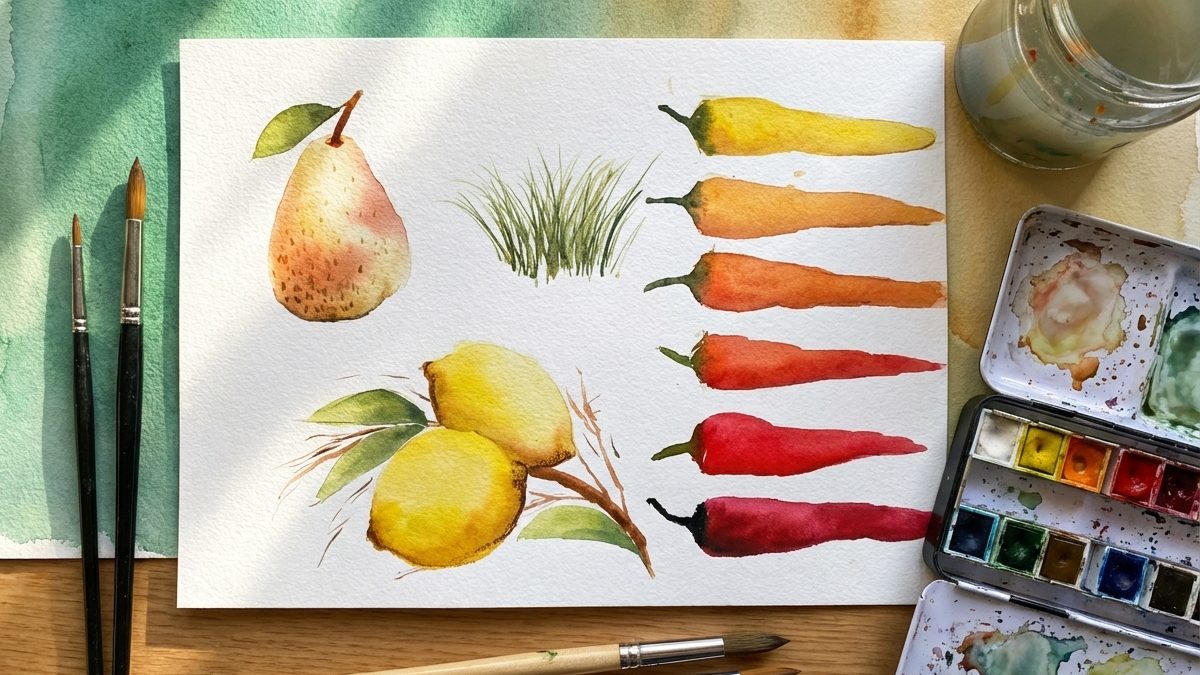
Having learned color and tone control through scale work, the student is now ready for their first real subject. Instructor Şirvan begins with simple fruit and flower studies in this step — and there's a very special reason for this. Fruits and flowers are the perfect starting point for learning watercolors. Their forms are familiar — everyone knows what an apple or a rose looks like. This familiarity allows the student to focus on technique rather than the subject. Also, organic forms don't have to be perfect — small deviations look natural and are forgiving. What will be learned in this step:
Form and volume — moving from flat surfaces to three-dimensional form. Creating depth using light and shadow.
Color transitions — blending multiple colors on a single object. From the red of an apple to its green, from the light pink to the dark shade of a rose.
Wet-on-wet technique in practice — the wet-on-wet technique learned in scale work is applied to a real subject for the first time.
Detail and contour — the final touches of the work, fine details with a contour brush. Learning when to finish a work is also part of this step.
Simple Landscape Studies
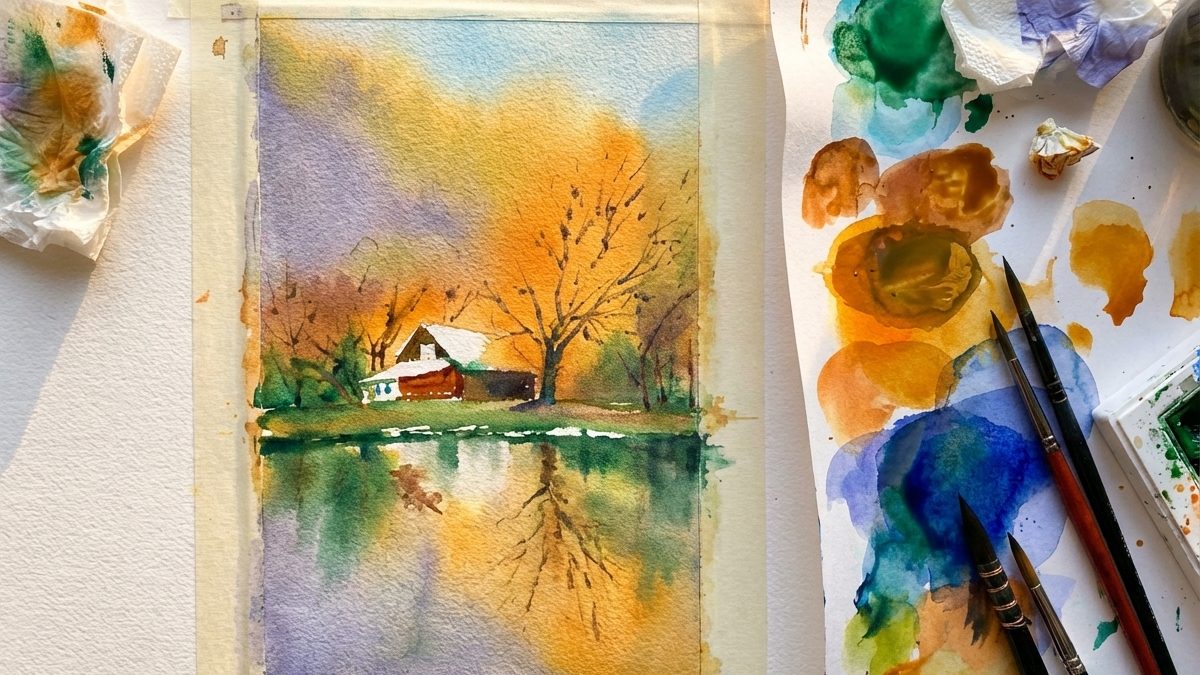
Having mastered form, volume, and color transitions through fruit and flower studies, the student is now ready for the most exciting step: simple landscapes. This step is where everything learned is used together, where the watercolorist truly expresses themselves for the first time.
Professor Şirvan doesn't start with complex compositions in this step. A simple sky, a quiet lake, a single tree, or the silhouette of a distant mountain — simplicity here is not a restriction, but a freedom. Learning to create a powerful composition with few elements is also the foundation of the advanced level.
What will be learned in this step:
Composition — knowing where to put what. Horizon line, foreground and background balance. How the eye moves in the painting.
Atmosphere and depth — distant objects being faint, close ones being dark. Bringing air, fog, and light to the paper.
Wide field techniques — large sky washes, water reflections, wide ground paintings. Flat wash and wet-on-wet truly come to life in this step.
Speed and freedom — landscape studies invite the student to be freer, more spontaneous. Moving away from perfectionism and seizing the moment is the most valuable gain from this step.
Why does this sequence work?
In Bysirvan's curriculum, each step lays the groundwork for the next. This sequence is not random — it's a system developed over years of working with thousands of students, observing firsthand what works. You can't learn technique without knowing the material. You can't create form without learning to control tone. You can't capture the volume of a tree in a landscape without knowing form. Each step builds upon the previous one — and this building process simultaneously develops both the student's self-confidence and technical knowledge. Beginner Level: A 6-Week Journey
Bysirvan's beginner level curriculum is structured over 6 weeks. The first two weeks focus on material identification and scale studies — establishing the foundation. The third and fourth weeks focus on organic forms such as flowers, trees, and wreaths — reinforcing form, volume, and color transitions in real-world subjects. The fifth and sixth weeks move on to simple landscapes — the most exciting stage, where everything learned is used together.
At the end of six weeks, the student hasn't just learned a few techniques — they have established a real relationship with watercolor. They have begun to feel the brush naturally in their hand, to trust the water, and to be less apprehensive in front of the paper. Homework and Assessment: Not Just Watching, But Doing
A homework assignment is given each week. The student applies the topic at home and shares their work. Ms. Şirvan evaluates each student's work individually — both the work done in class and the weekly assignments. The assessment is twofold: on the one hand, the strengths of the work are highlighted, motivating the student; on the other hand, mistakes are clearly shown, and how to improve is explained. This balance — encouragement and honesty together — is the essence of Ms. Şirvan's educational philosophy. Learning by doing and receiving feedback, not just watching, makes the process permanent.
How long will it take me to progress?
This is one of the most frequently asked questions by those starting to learn watercolor painting. The honest answer is: everyone progresses at a different pace — and that's perfectly normal.
Bysirvan's observation is this: a student who works regularly, does their homework, and is open to feedback will paint like someone they don't recognize after completing the 6-week beginner curriculum. Dedicating a few hours a week, rewatching each lesson, and completing homework without skipping any makes this transformation possible.
At Bysirvan, you progress at your own pace.
Lessons are recorded — you can rewatch them as many times as you want, whenever you want. You don't have to move on without fully understanding a technique. Some students watch the same lesson three times, others pass in one go. Both are correct — the important thing is to understand and apply. Transitioning between levels
After completing the beginner curriculum, the student moves on to the intermediate level. At the intermediate level, more complex compositions, richer color studies, and a freer language of expression are developed. At the advanced level, the student begins to find their own style. Each level builds upon the previous one — slowly, with steady steps.
From Şirvan Hoca
"Learning watercolor painting isn't a race. Every brushstroke, every assignment, every repetition takes you one step forward. The important thing is to proceed in the right order, at the right pace."
Would you like to learn through the curriculum?
Start in the Right Order, Feel the Difference.
With the curriculum developed over the years by Şirvan Hoca, this is the right place to learn watercolor painting. Progress step by step—at your own pace, with opportunities for revision and expert feedback.