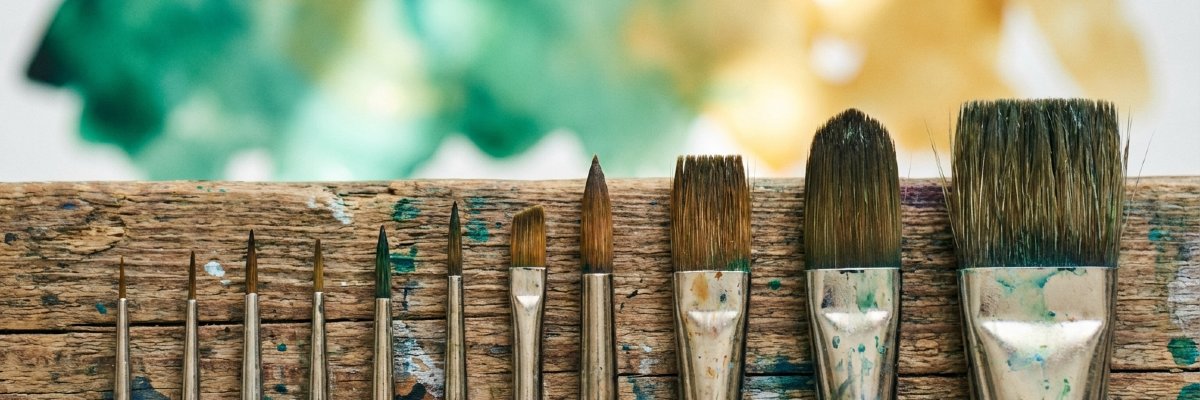
Starting with the right brush makes watercolor easier. With the 5 brushes recommended by Şirvan Hoca, you can do everything from fine details to broad washes.
Why is the Right Brush So Important?
In watercolor, a brush is more than just a tool — it's the bridge between the water and the painter. The right brush controls the flow of paint, determines the sensitivity of the touch, and directly affects the development of technique. There are two common mistakes beginners make: either buying very cheap, low-quality brushes or accumulating dozens of brushes of all kinds before starting. Both are unnecessary. What Şirvan Hoca has taught his students for years is this: 5 right brushes are worth far more than 50 wrong ones. In this guide, you will find the basic brush types used in watercolor, what each one is for, and what you really need to start with. Read this guide before you go brush shopping — you'll save both money and time.
Round Brush — An indispensable tool for watercolorists.
The round brush is the watercolorist's most basic tool. Its tip allows for fine detail lines while its body comfortably paints large areas — you can work both precisely and freely with a single brush. If you could only carry one brush for watercolor painting, this would be it.
Professor Şirvan recommends that beginners start with 4 different numbers. The smallest number is for fine details and narrow areas, while the largest number is for large surfaces and background painting. These 4 brushes complement each other — working by constantly switching between them creates a natural rhythm in watercolor.
Which numbers?
Professor Şirvan's suggested combination: No. 1, No. 4, No. 7, and No. 10. Or a set of 5 such as No. 1, No. 3, No. 5, No. 7, and No. 10 can also be preferred — the second option makes the transition between them smoother.
Regarding brush quality:
The most important feature of a round brush is the tip quality. When wet, the tip of a good round brush should gather in a single point and not spread. The easiest way to test this in the store is to dip the brush in water and shake it — if the bristles, it's a good quality.
Contour Brush — The Address for Fine Details
A contour brush reaches places a round brush cannot. This brush, with its very fine and long tip, is designed for branches, veins, feathers, hair strands, fine lines, and contours. The final touches, fine details, and sharp edges of compositions created with other brushes come to life with this brush. Professor Şirvan includes a contour brush in the set for beginners. Although used sparingly at first, it becomes indispensable as you progress — especially for flower veins, tree branches, and lettering.
How to use it?
The contour brush should have very little paint and very little water. Lightly touch the brush to the paper and draw it with a continuous and calm motion. Rushing will make the line wavy — working with this brush is also an exercise in patience and focus. Professor Şirvan's suggestion:
For beginners, the No. 1 contour brush is sufficient. You can choose from economical but high-quality synthetic series — the tip quality is also crucial in a contour brush.
Other Brush Types: Things You Can Add to Your Collection As You Progress
Round and contour brushes are all you need to start with. But as your watercolor journey progresses, different brush types add new dimensions to your work. You don't need to buy them right away — get to know them so you know what you're looking for when the time comes.
Flat Brush
This rectangular brush is used for painting large flat areas and creating sharp edges. It is ideal for skies, seas, and large backgrounds. It is also frequently preferred in architectural work and geometric compositions.
Mop Brush
With its large, balloon-shaped body, it carries a large amount of water and paint. It is invaluable for large background washes and wet-on-wet techniques. It is perfect for soft cloud effects, fog, and wide color transitions. Once you use it, you won't want to remove it from your collection.
Fan Brush
This fan-shaped brush is used to apply many fine lines at once, such as grass, dry grass, hair, and feathers. It is especially useful for creating texture and nature studies.
Hake Brush
This large, flat brush of Japanese origin is used for washing very large areas. Ideal for painting backgrounds in large format works of A3 and above.
Synthetic or Natural Bristle?
This is one of the most frequently asked questions about brush selection. The short answer: synthetic for beginners, natural bristles for advanced levels, depending on preference.
Synthetic Brushes
Produced with modern manufacturing technology, synthetic brushes are the ideal choice for beginners. They are affordable, durable, and easy to maintain. High-quality synthetic brushes perform very close to natural bristles — the difference in water retention capacity and tip flexibility has significantly decreased. Şirvan Hoca initially prefers economical but high-quality synthetic series; he reminds every student that a good brush doesn't have to be expensive.
Natural Bristle Brushes
Squirrel and Kolinsky sable are the most preferred types of natural bristles. Their water retention capacity is significantly higher compared to synthetic — the brush stays wet longer, and the paint flow is more controlled and smooth. However, they are expensive and require maintenance. At an advanced level, as your technique matures, you will begin to feel this difference. Conclusion:
Start with a high-quality synthetic series initially, and as your technique progresses, explore natural bristle brushes. Your brush collection will naturally evolve over time — every artist has a different set.
Brush Care: A well-cared-for brush lasts a lifetime.
A quality brush, when properly cared for, can last for years, even decades. Conversely, even an expensive brush will be ruined in a few months with poor care. In Şirvan Hoca's workshop, brush care is as important as technique — respecting your tools is respecting your art.
After Each Use
Carefully wash brushes with lukewarm water. Gently squeeze out the paint from root to tip — do not bend or twist the brush, as this will damage the bristles. After washing, gently squeeze out excess water and return the tip to its original shape.
Drying
Never leave brushes in a glass with the tip facing upwards — the water will go down to the root, the glue will dissolve, and the bristles will fall out. Dry on a horizontal surface or in a brush holder with the tip facing downwards. If Not to Be Used for a Long Time
Store completely dry brushes in a roller or brush case to protect the bristles. Keep in a cool place away from moths and moisture.
If the Paint Has Dried
If the paint has dried on the brush, soak it in lukewarm water for an extended period. If it is very stubborn, a brush cleaner solution can be used. Never use hot water — the bristles will lose their shape. When Using Masking Fluid
Do not apply masking fluid with a cheap or old brush — it can ruin your valuable brushes. Soap the brush tip before application, this will create a protective layer.
Frequently Asked Questions About Brushes
How many brushes are enough for beginners?
5 brushes are sufficient: No. 1, No. 4, No. 7, and No. 10 round brushes, plus No. 1 contour brush. This set covers everything from fine details to broad washes, from contour lines to free brushstrokes. You can expand your collection as your technique progresses.
What does the brush number mean?
The number indicates the size of the brush — a small number means fine and small, a large number means wide and large. However, standards can vary slightly from brand to brand; one brand's No. 8 might be as large as another brand's No. 10. Choose by physically seeing them if possible.
Can you learn watercolor with cheap brushes?
Very cheap brushes — especially models whose tips fray and don't hold water — make learning technique difficult. Economical but high-quality synthetic series offer an excellent starting point. A small investment in brushes significantly eases the learning process.
When should I replace my brushes?
It's time to replace them when the tip deforms, the bristles start shedding, or the brush no longer gives you the precision you want. A well-maintained, high-quality brush won't reach this point for years. Should I use different brushes for different techniques? Initially, no — flat wash, wet-on-wet, and dry brush techniques can all be applied with a round brush. As you progress, you might start using a mop brush for wet-on-wet and a flat brush for wider washes. This transition comes naturally.
Recommended Brushes
Suggested brushes will be here very soon.
You've chosen your brush, now start painting!
Choose your brush, take your first brush stroke.
Starting with the right brush will make your watercolor journey easier. You can check out the brush set recommended by Şirvan Hoca and be ready to paint with a single order.